The Blue Mosque—a jewel of Istanbul and a masterpiece of classical Ottoman architecture
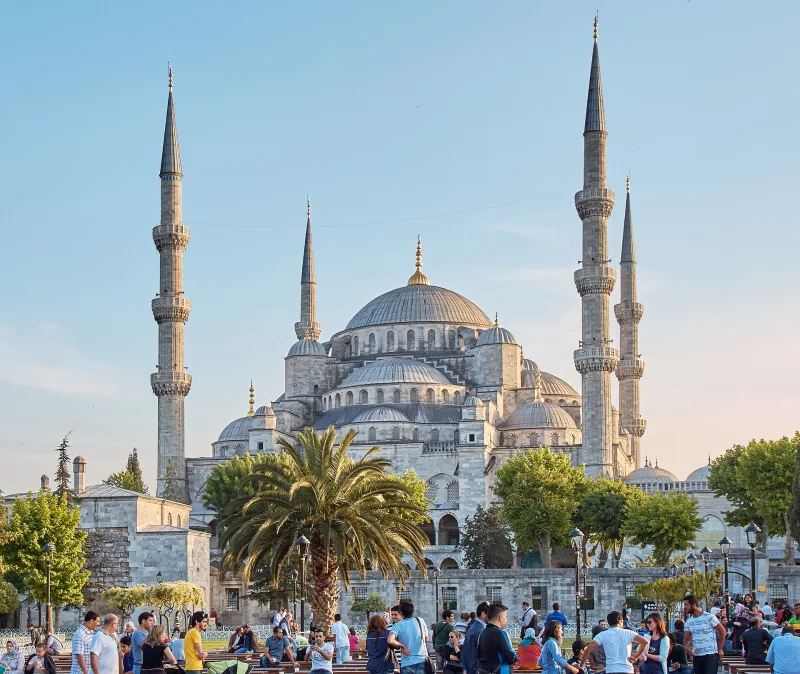
The Blue Mosque, officially known as the Sultan Ahmed Mosque (Sultan Ahmet Camii), is one of Turkey’s most recognizable landmarks and a symbol of Istanbul. Built between 1609 and 1617 at the behest of the young Sultan Ahmed I, it became the last great imperial mosque of the classical Ottoman period and, at the same time, an architectural response to the Hagia Sophia standing opposite it. The Blue Mosque earned its unofficial name thanks to the more than 20,000 white and blue Iznik tiles that adorn its interior. In 1985, along with the entire Sultanahmet district, the Blue Mosque was added to the UNESCO World Heritage List. Today, it is not just an open-air museum but an active mosque that welcomes thousands of worshippers and tourists every day.
History and Origin of the Blue Mosque
The Blue Mosque was built during the reign of Sultan Ahmed I, who ascended the throne at the age of 14 and ruled during a difficult period for the Ottoman Empire. By the early 17th century, the empire was experiencing its first serious crisis: a series of defeats in wars against Austria, Persia, and the Polish-Lithuanian Commonwealth, along with internal rebellions and economic problems, were undermining the sultans’ prestige. The 1606 Treaty of Zítva-Torok, which ended the war with the Habsburgs without the territorial gains customary for the Turks, was perceived as a blow to the empire’s honor. It was in this context that the young Ahmed I decided to build a massive mosque in Istanbul as a sign of his plea to God for blessings upon the empire.
Construction began in 1609 under the direction of architect Sedefkar Mehmed-Aga, a student of the famous Mimar Sinan. The site was chosen for its symbolic significance: directly opposite Hagia Sophia, on the southern side of the ancient Hippodrome of Constantinople, in the heart of the old city. To make way for it, several palaces from the Byzantine and early Ottoman periods had to be demolished. Ahmed I personally oversaw the construction, and the mosque became the first imperial mosque built in Istanbul in 42 years, following the Selim II Mosque. It was officially opened in 1617, just a few months before the sultan’s death at the age of 27.
Over the next four centuries, the Blue Mosque remained an active Muslim place of worship and one of Istanbul’s main symbols. It has survived several earthquakes and restorations. The most recent major restoration was completed in 2023: the domes, minarets, carpets, and lighting system were all updated. Now the mosque once again shines in all its glory.
Architecture and What to See at the Blue Mosque
The Blue Mosque is the pinnacle of classical Ottoman architecture, which developed over more than a century based on a synthesis of Byzantine traditions (primarily Hagia Sophia) and Seljuk domed mosques. Its structure represents the final great development of this tradition.
Six minarets—a unique feature
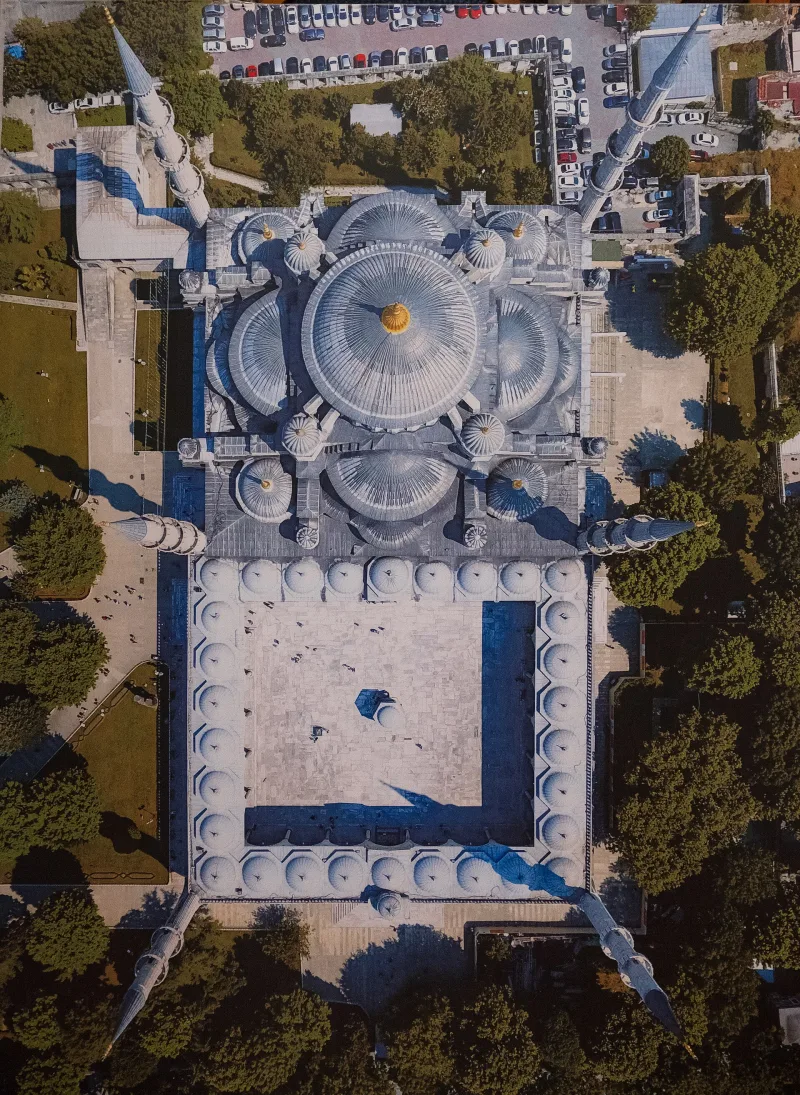
The Blue Mosque is the only mosque in Istanbul with six minarets, which was considered almost scandalous at the time of its construction. According to one legend, the sultan ordered “golden minarets” (altın minareler), but the architect heard “six minarets” (altı minare) and rendered this in stone. The mosque’s six minarets were matched only by the Masjid al-Haram in Mecca, which caused discontent among the Muslim clergy. To resolve the conflict, Ahmed I funded the construction of a seventh minaret in Mecca, restoring its exclusivity.
The Main Dome and System of Semi-Domes
The central dome of the mosque has a diameter of 23.5 meters and a height of 43 meters. It rests on four gigantic “elephant pillars” and is surrounded by four semi-domes, which in turn are surrounded by even smaller semi-domes, creating a cascading composition that elegantly distributes the weight. This system allows for a vast, open prayer space without internal supports.
Iznik tiles—the source of the name
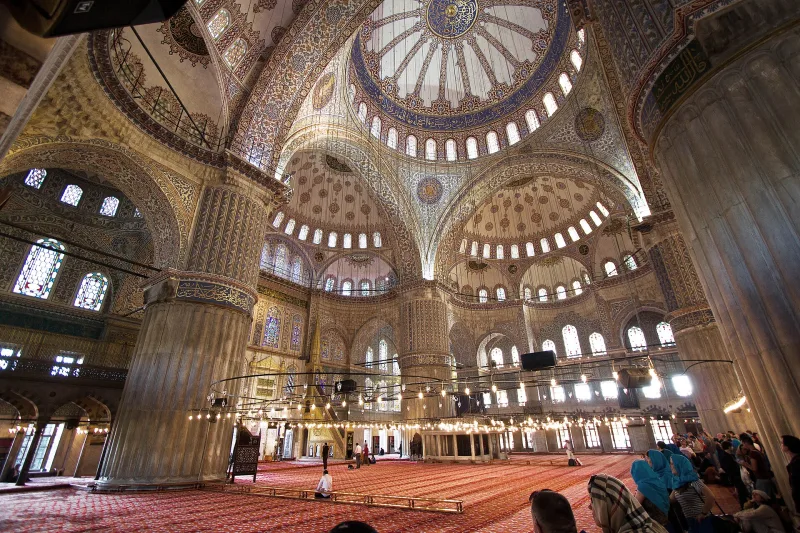
The mosque’s primary artistic value lies in its more than 20,000 ceramic tiles (izrazci) brought from Iznik, the Ottoman Empire’s largest center of ceramics. They depict tulips, carnations, roses, cypress trees, and grapevines in a white-and-blue palette. These tiles cover the upper galleries and walls and are particularly beautiful in the northern part of the mosque. Producing so many tiles cost the treasury so much that Emperor Ahmed set fixed prices, which led to the decline of the Iznik workshops.
The Mihrab, Minbar, and Dome Paintings
The white marble mihrab, inlaid and decorated with delicate arabesque carvings, indicates the direction of Mecca. Next to it stands the minbar—a pulpit for sermons made of the same marble. The interior painting of the dome and semi-domes is executed in red and blue paint with gilding. More than 200 stained-glass windows create soft, diffused lighting that changes throughout the day.
The inner courtyard and the kulliya complex
Adjacent to the mosque is a large courtyard with a fountain for ablutions in the center. The courtyard is surrounded by an arcade with 30 domes. The entire complex—the “külliye”—included a madrasa, an imaret (soup kitchen for the poor), a caravanserai, a hospital, a bazaar, an elementary school, and the mausoleum of Sultan Ahmed I himself and his family.
Architect Sedefkar Mehmed-aga—a student of Sinan
The chief architect of the Blue Mosque was Sedefkar Mehmed-aga, a student of the great Mimar Sinan. Born into an Albanian family and brought to Istanbul through the devshirme system (the recruitment of Christian boys into the sultan’s service), he rose from the position of mother-of-pearl inlay artist (hence the nickname “Sedefkar”—master of mother-of-pearl) to become the chief court architect. His autobiography, “Risale-i Mimariye,” which has survived to this day, is one of the most valuable documents on the history of Ottoman architecture. Mehmed-aga personally supervised every stage of construction and, according to legend, worked on the site from four in the morning until late at night, inspecting the quality of every stone and every tile.
The Formerly Known Hippodrome and Archaeological Context
The site chosen for the mosque held immense symbolic significance. It was the location of the ancient Byzantine hippodrome, which could accommodate up to 100,000 spectators and hosted chariot races, gladiatorial combats, and coronation ceremonies. In the 13th century, during the Fourth Crusade, the hippodrome was looted, and Lysippos’s famous bronze quadriga was taken to Venice, where it now adorns St. Mark’s Basilica. Today, only three monuments remain from the hippodrome—the Obelisk of Theodosius (an Egyptian obelisk from Luxor, 15th century BCE), the Serpent Column (5th century BCE, from Delphi), and the Constantinople Obelisk. All of them stand directly in front of the Blue Mosque, forming one of the most historically layered ensembles in the world: millennia-old monuments of ancient Egypt and classical Greece, the Byzantine Hippodrome, and the Ottoman imperial mosque—all within a radius of one hundred meters.
Stained-glass windows and chandeliers
The mosque’s unique atmosphere is created by more than 260 stained-glass windows, arranged in several rows on the walls and the dome’s drum. The original 17th-century stained-glass windows were crafted by the master Ibrahim “the Drunkard” (Sarhoş İbrahim), who also worked at the Süleymaniye Mosque. Unfortunately, most of the originals were lost as a result of fires and earthquakes, and the modern stained-glass windows are 19th-century replicas. The soft light passing through them bathes the interior in shades of blue and green, enhancing the color symphony of the Iznik tiles. The lighting is complemented by enormous crystal chandeliers suspended on chains just a few meters above the floor—an original design in which the light first reflects off the floor and carpets and then rises toward the vaulted ceiling, creating an effect of “inner radiance.”
Restoration 2017–2023
The large-scale restoration, completed in 2023, took more than six years and cost the Turkish government over 35 million lira. The work included reinforcing the domes, replacing damaged Iznik tiles with replicas made using the same 16th-century techniques in modern Iznik workshops, renewing the carpets (which were woven specifically for the mosque and correspond to original Ottoman designs), cleaning the calligraphic murals, and restoring the stained-glass windows. During the work, only partial access was granted to visitors, which allowed archaeologists and art historians to conduct the most detailed study of the mosque in its entire history. Some discoveries proved unexpected: beneath 19th-century plaster on one of the walls, fragments of the original 1617 mural with floral motifs were discovered, which had previously been considered lost.
Interesting Facts and Legends
- The cost of building the mosque was so high that Ahmed I, lacking sufficient war booty (mosques were typically funded from military spoils), used funds from the state treasury, which drew criticism from the ulema.
- In 1826, the Blue Mosque became the center of significant historical events: Sultan Mahmud II announced the dissolution of the Janissary corps here, an event known as the “Blessed Incident” (Vaka-yi Hayriye).
- The mausoleum of Sultan Ahmed I, located in the northeast corner of the complex, contains the tombs of the sultan himself, his wife Kösem, and his sons Osman II and Murad IV.
- During his visit to Istanbul in 2006, Pope Benedict XVI visited the Blue Mosque—this was only the second time in history that a pope had visited a Muslim place of worship, following Pope John Paul II.
- The Blue Mosque was never the “largest” mosque in the Ottoman Empire, but it is considered one of the most beautiful thanks to its combination of tiles, stained-glass windows, and a cascade of domes.
How to get to the Blue Mosque
The Blue Mosque is located in the Sultanahmet district, within walking distance of Hagia Sophia (across the square of the same name) and Topkapi Palace. The nearest public transportation stop is the T1 tram “Sultanahmet,” just a 3–5-minute walk away. The tram connects Sultanahmet with Eminönü, the Grand Bazaar, Kapalı Çarşı, and Kabataş (where you can transfer to the funicular to Taksim).
The most convenient way to get from IST International Airport to Sultanahmet is by taking the M11 metro, transferring to the M7, and then taking the T1 tram (total travel time is about 1.5 hours). A taxi is faster but significantly more expensive. Entrance to the mosque itself is free for everyone, but during the five daily prayers (five times a day, including Friday noon prayer), access for non-Muslims is temporarily closed. There are signs with the prayer schedule at the north and south entrances.
Tips for Travelers
The best time to visit is early morning or closer to sunset, when the light is soft and the crowds are smaller. Avoid the Friday noon prayer (usually from 12 :30 to 14 :30). Following its 2023 restoration, the Blue Mosque is once again fully open to visitors, and its interior shines brighter than ever.
Strict dress code: women must cover their heads, shoulders, and knees (scarves are provided free of charge at the entrance); men must not wear shorts above the knee. Remove your shoes and place them in a plastic bag, which is also provided. Inside the mosque, please be quiet and respectful: this is an active place of worship, and believers may be praying nearby. Photography is permitted, but without a flash.
Be sure to walk around the mosque from the outside, especially from the Grand Bazaar side—this offers the best view of the six minarets and the cascade of domes. In the evening, when illuminated, the mosque looks particularly impressive. Best itinerary: tour of Hagia Sophia → tea break on the terrace of a café with a view → Blue Mosque → Basilica Cistern → Grand Bazaar. Between the mosque and Hagia Sophia is a garden with fountains where you can relax between visits. The mosque complex also houses a small, free museum detailing the history of its construction and restoration—it’s easy to miss, but it’s worth a visit.